
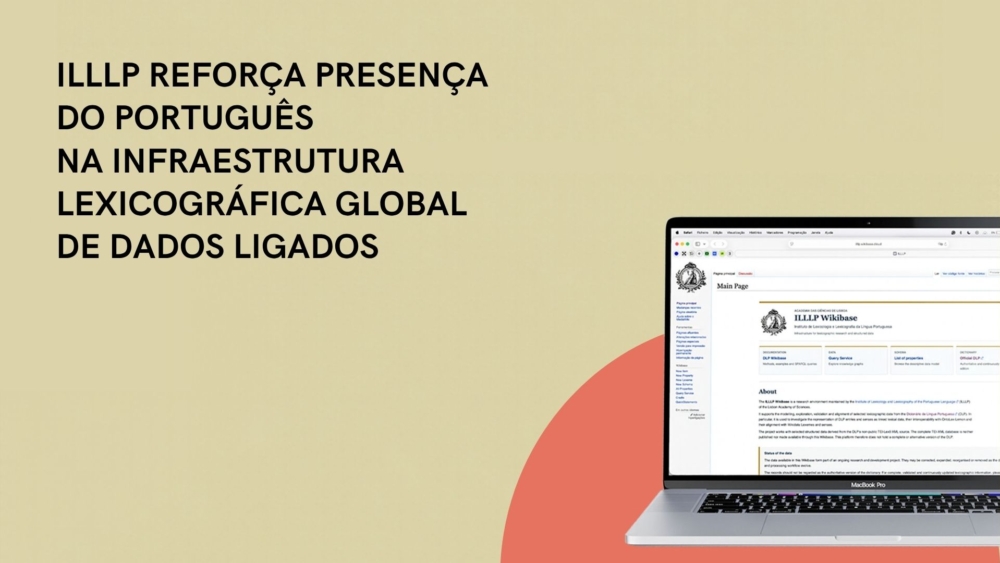
The Institute of Lexicology and Lexicography of the Portuguese Language (ILLLP) at the Academy of Sciences of Lisbon is strengthening the presence of the Portuguese language within major international linguistic data infrastructures.
As part of a project carried out in collaboration with the University of the Basque Country (EHU), around 70,000 entries from the Dictionary of the Portuguese Language (DLP) have been integrated into Wikidata’s Lexemes, the section of Wikidata dedicated to the structured representation of words, forms and meanings. The data can also be explored on the ILLLP Wikibase, the platform where it is structured, linked and progressively enriched.
This work enables DLP data to be searched, linked to other resources and reused in different digital environments, whilst always maintaining a link to the dictionary’s original entry.
To make this integration possible, data from the DLP was converted into international formats for representing lexicographical information and organised within the ILLLP Wikibase. The process does not, however, amount to a simple automatic data transfer.
A significant editorial validation process was required, particularly to verify the correspondence between the meanings described in the DLP and the concepts represented in Wikidata. These decisions require specialised lexicographical work, as the distinctions established in a dictionary must be accurately represented in a new data environment.
Portuguese among the ten languages with the most lexemes on Wikidata
The impact of this work is already evident in the international representation of the Portuguese language.
According to data provided by Ordia, a tool for exploring lexicographical data on Wikidata, Portuguese is currently among the ten languages with the highest number of lexemes recorded on the platform.
This growing presence helps to make Portuguese lexical data more accessible and reusable by researchers, Digital Humanities projects, natural language processing applications and artificial intelligence systems.
The next stage involves the gradual enrichment of Portuguese lexemes with new information, including inflected forms, etymologies, examples of usage in corpora, pronunciations and links between meanings and concepts.
At the same time, the analysis of this data makes it possible to identify inconsistencies or missing information within the dictionary itself. The reuse of the data thus creates a feedback loop: it also helps the Academy’s lexicographers to review and improve the DLP.
The project therefore represents a further step towards transforming the digital dictionary into a genuine knowledge infrastructure for the Portuguese language, capable of being consulted by the public, explored by researchers and reused by computer systems.
