
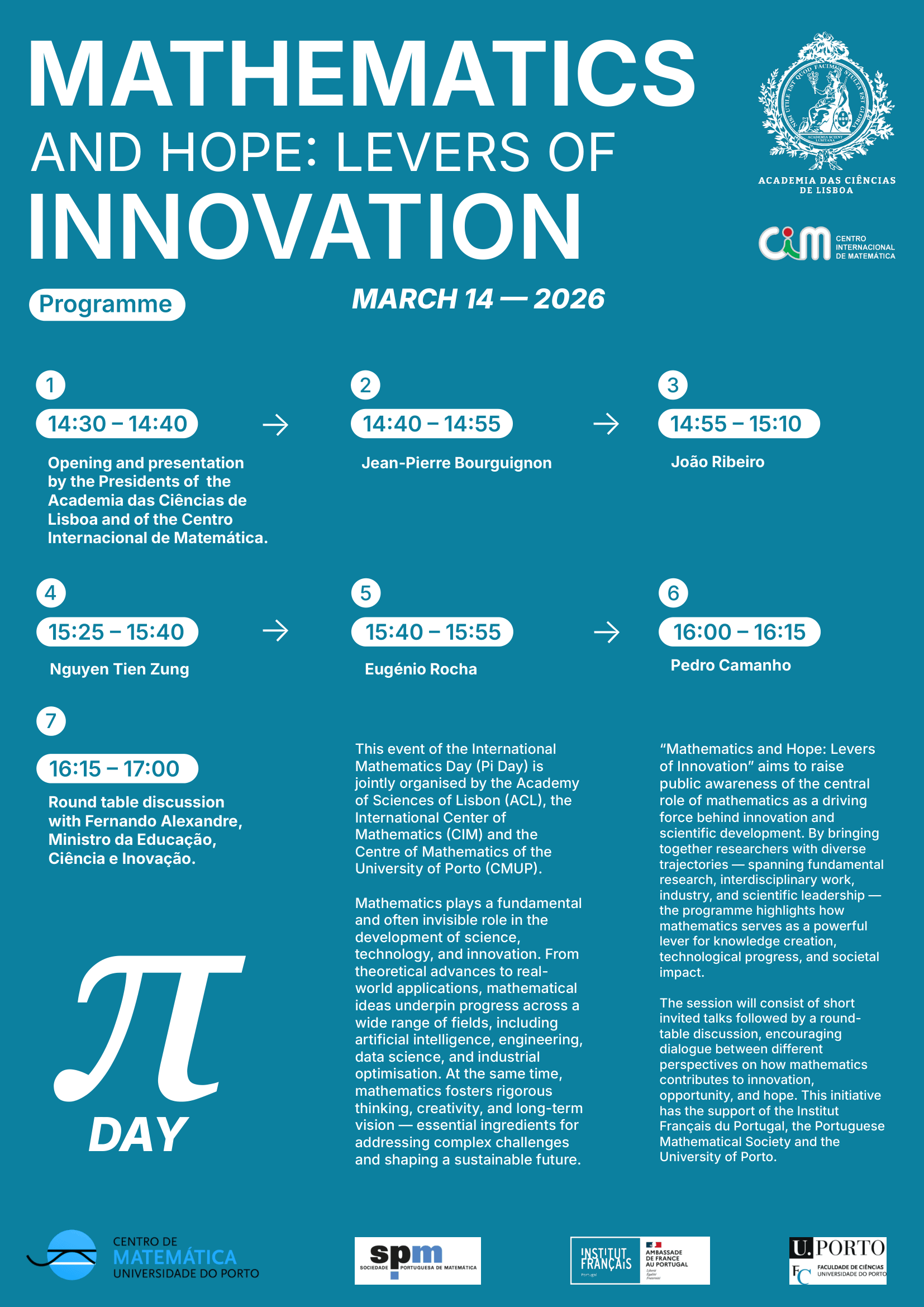
Mathematics and Hope: Levers of Innovation
Matemática e esperança: alavancas da inovação
Local: Faculdade de Ciências da Universidade do Porto
Assista remotamente através dos links:
Sessão: https://www.youtube.com/live/u-JdclMNwf4?is=kxJdLNUVWWVIIBIY
Mesa-redonda: https://youtu.be/dg0tPNLabMc
Fotografias do evento disponíveis nas redes sociais: LinkedIn, Facebook, Instagram.
Programa:
14h30 – 14h40 | Abertura e apresentação do evento Presidentes da Academia das Ciências de
Lisboa e do Centro Internacional de Matemática
14h40 – 14h55 | Jean-Pierre Bourguignon
14h55 – 15h10 | João Ribeiro
15h25 – 15h40 | Nguyen Tien Zung
15h40 – 15h55 | Eugénio Rocha
16h00 – 16h15 | Pedro Camanho
16h15 – 17h00 | Mesa redonda com todos os oradores e Fernando Alexandre, Ministro da Educação, Ciência e Inovação.
O evento do Dia Internacional da Matemática (Dia do Pi) é organizado pela Academia das Ciências de Lisboa (ACL), pelo Centro Internacional de Matemática (CIM) e pelo Centro de Matemática da Universidade do Porto (CMUP).
A matemática desempenha um papel fundamental e muitas vezes invisível no desenvolvimento da ciência, da tecnologia e da inovação. Desde avanços teóricos até aplicações no mundo real, as ideias matemáticas sustentam o progresso numa ampla gama de campos, incluindo inteligência artificial, engenharia, ciência de dados e otimização industrial.
Simultaneamente, a matemática promove o pensamento rigoroso, a criatividade e a visão de longo prazo — ingredientes essenciais para enfrentar desafios complexos e moldar um futuro sustentável.
“Matemática e Esperança: Alavancas da Inovação” pretende sensibilizar o público para o papel central da matemática como força motriz da inovação e do desenvolvimento científico. Ao reunir investigadores com trajetórias diversas — abrangendo investigação fundamental, trabalho interdisciplinar, indústria e liderança científica —, o programa destaca a matemática como uma alavanca poderosa para a criação de conhecimento, o progresso tecnológico e o impacto social.
A sessão consistirá em breves apresentações de convidados, seguidas de uma mesa redonda sobre como a matemática contribui para a inovação, a oportunidade e a esperança. Esta iniciativa conta com o apoio do Institut Français du Portugal, da Sociedade Matemática Portuguesa e da Universidade do Porto.
Jean-Pierre Bourguignon é um matemático francês cujo trabalho em geometria diferencial teve uma influência duradoura na área. Formado pela École Polytechnique e pela Universidade Paris Diderot, onde concluiu o seu doutoramento sob a orientação de Marcel Berger, combinou contribuições científicas profundas com uma liderança excecional em matemática. Foi diretor do Institut des Hautes Études Scientifiques (IHÉS) durante quase duas décadas. Foi o segundo presidente da Sociedade Matemática Europeia e, mais tarde, tornou-se presidente do Conselho Europeu de Investigação. Amplamente reconhecido pelo seu papel na promoção da excelência matemática e da visão científica a longo prazo, recebeu várias distinções internacionais e é membro honorário ou estrangeiro de várias academias e sociedades científicas.
João Ribeiro é professor auxiliar no Departamento de Matemática do Instituto Superior Técnico (ULisboa) e investigador no Instituto de Telecomunicações. O seu percurso académico liga a matemática, a ciência da computação, e a engenharia eletrotécnica através da sua formação em matemática aplicada, ciência da computação e um doutoramento pelo Imperial College London. A sua investigação centra-se na teoria de códigos, criptografia, teoria da informação e pseudoaleatoriedade, áreas em que ideias matemáticas profundas sustentam a segurança e a comunicação digitais modernas. Após um trabalho de pós-doutorado na Carnegie Mellon University e estadias de investigação em várias instituições internacionais de renome, foi recentemente galardoado com uma bolsa ERC Starting Grant, destacando o potencial inovador da investigação matemática na ciência da computação e na engenharia eletrotécnica.
Nguyen Tien Zung é um matemático reconhecido internacionalmente pelas suas contribuições para a topologia simplética, sistemas hamiltonianos integráveis e geometria de Poisson. O seu trabalho clarificou a estrutura geométrica e topológica de sistemas dinâmicos com singularidades, enfatizando o papel central da simetria e das ações de toro. Após uma carreira académica de sucesso, incluindo cargos na França e na Ásia, fundou a Torus AI em 2019, onde atua como CEO e diretor científico. Através da Torus AI, aplica o pensamento matemático à inteligência artificial, ao processamento de sinais e a modelos generativos, promovendo ativamente uma visão ética e orientada para o impacto da tecnologia. A sua trajetória exemplifica como uma profunda compreensão matemática pode impulsionar a inovação para além do meio académico.
Eugénio Rocha é professor associado de Matemática na Universidade de Aveiro e atual presidente da Sociedade Matemática Portuguesa. Com formação académica em inteligência artificial, matemática e teoria de controlo não-linear, o seu trabalho abrange tanto a matemática teórica como a aplicada. Tem várias publicações em áreas como equações diferenciais, otimização, teoria de controlo e modelação matemática, com aplicações que vão da biologia e epidemiologia à engenharia, economia e educação. Paralelamente à sua atividade académica, tem desempenhado um papel central na coordenação de equipas multidisciplinares em projetos de grande escala nas áreas da manufatura, logística, ciência de dados e aprendizagem automática (machine learning), ilustrando como a matemática serve de ponte entre a teoria, a computação e a inovação no mundo real.
Pedro Camanho é professor catedrático de Engenharia Mecânica na Universidade do Porto e especialista internacionalmente reconhecido em mecânica de materiais compósitos avançados. Obteve o seu doutoramento no Imperial College London e liderou investigações influentes sobre deformação, fratura e modelação multiescala de estruturas compostas leves para aplicações aeroespaciais e de engenharia. O seu trabalho baseia-se fortemente na modelação matemática e na mecânica computacional, tendo sido transposto com sucesso para a indústria, com métodos implementados em software de engenharia amplamente utilizado. Antigo líder de importantes instituições e programas de investigação, recebeu inúmeras distinções internacionais, incluindo uma recente bolsa ERC Advanced Grant, na vanguarda da inovação tecnológica.
A inscrição é obrigatória e pode ser efetuada aqui. Por motivos logísticos, solicitamos que os participantes efetuem a sua inscrição até ao dia 10 de março.
Programme
14h30 – 14h40 | Opening and presentation by the Presidents of the Academia das Ciências de Lisboa and of the Centro Internacional de Matemática.
14h40 – 14h55 | Jean-Pierre Bourguignon
14h55 – 15h10 | João Ribeiro
15h25 – 15h40 | Nguyen Tien Zung
15h40 – 15h55 | Eugénio Rocha
16h00 – 16h15 | Pedro Camanho
16h15 – 17h00 | Round table discussion with Fernando Alexandre, Ministro da Educação, Ciência e Inovação
This event of the International Mathematics Day (Pi Day) is jointly organised by the Academy of Sciences of Lisbon (ACL), the International Center of Mathematics (CIM) and the Centre of Mathematics of the University of Porto (CMUP).
Mathematics plays a fundamental and often invisible role in the development of science, technology, and innovation. From theoretical advances to real- world applications, mathematical ideas underpin progress across a wide range of fields, including artificial intelligence, engineering, data science, and industrial optimisation. At the same time, mathematics fosters rigorous thinking, creativity, and long-term vision — essential ingredients for addressing complex challenges and shaping a sustainable future.
“Mathematics and Hope: Levers of Innovationˮ aims to raise public awareness of the central role of mathematics as a driving force behind innovation and scientific development. By bringing together researchers with diverse trajectories — spanning fundamental research, interdisciplinary work, industry, and scientific leadership — the programme highlights how mathematics serves as a powerful lever for knowledge creation, technological progress, and societal impact.
The session will consist of short invited talks followed by a round- table discussion, encouraging dialogue between different perspectives on how mathematics contributes to innovation, opportunity, and hope. This initiative has the support of the Institut Français du Portugal, the Portuguese Mathematical Society and the University of Porto
Jean-Pierre Bourguignon is a French mathematician whose work in differential geometry has had a lasting influence on the field. Trained at the École Polytechnique and Paris Diderot University, where he completed his PhD under Marcel Berger, he has combined deep scientific contributions with exceptional leadership in mathematics. He served as Director of the Institut des Hautes Études Scientifiques (IHÉS) for nearly two decades. He was the second President of the European Mathematical Society and later he became President of the European Research Council. Widely recognised for his role in promoting mathematical excellence and long-term scientific vision, he has received several international distinctions and is an honorary or foreign member of multiple academies and learned societies.
João Ribeiro is an Assistant Professor in the Department of Mathematics at Instituto Superior Técnico (ULisboa) and a researcher at the Instituto de Telecomunicações. His academic path bridges mathematics and computer science, with training in applied mathematics, computer science, and a PhD from Imperial College London. His research focuses on coding theory, cryptography, information theory, and pseudorandomness, areas where deep mathematical ideas underpin modern digital security and communication. After postdoctoral work at Carnegie Mellon University and research stays at several leading international institutions, he was recently awarded an ERC Starting Grant, highlighting the innovative potential of mathematically driven research in theoretical computer science.
Nguyen Tien Zung is a mathematician internationally recognised for his contributions to symplectic topology, integrable Hamiltonian systems, and Poisson geometry. His work has clarified the geometric and topological structure of dynamical systems with singularities, emphasising the central role of symmetry and torus actions. After a successful academic career, including positions in France and Asia, he founded Torus AI in 2019, where he serves as CEO and scientific director. Through Torus AI, he applies mathematical thinking to artificial intelligence, signal processing, and generative models, while actively promoting an ethical and impact-driven vision of technology. His trajectory exemplifies how deep mathematical insight can drive innovation beyond academia.
Eugénio Rocha is an Associate Professor of Mathematics at the University of Aveiro and the current President of the Portuguese Mathematical Society. With academic training in artificial intelligence, mathematics, and nonlinear control theory, his work spans both theoretical and applied mathematics. He has published extensively in areas such as differential equations, optimisation, control theory, and mathematical modelling, with applications ranging from biology and epidemiology to engineering, economics, and education. Alongside his academic activity, he has played a central role in coordinating multidisciplinary teams in large-scale projects related to manufacturing, logistics, data science, and machine learning, illustrating how mathematics serves as a bridge between theory, computation, and real-world innovation.
Pedro Camanho is a Full Professor of Mechanical Engineering at the University of Porto and an internationally recognised expert in the mechanics of advanced composite materials. He obtained his PhD from Imperial College London and has led influential research on deformation, fracture, and multiscale modelling of lightweight composite structures for aerospace and engineering applications. His work relies heavily on mathematical modelling and computational mechanics and has been successfully transferred to industry, with methods implemented in widely used engineering software. A former leader of major research institutions and programmes, he has received numerous international distinctions, including a recent ERC Advanced Grant, in the cutting-edge of technological innovation.
Registration is mandatory and can be completed here. For logistical purposes, we kindly ask participants to register by 10 March.
- 14 Mar 2026
- Concluídos
- 14:30 - 17:00
More Info
- Faculdade de Ciências da Universidade do Porto
Organiser
-
Academy of Sciences of Lisbon
