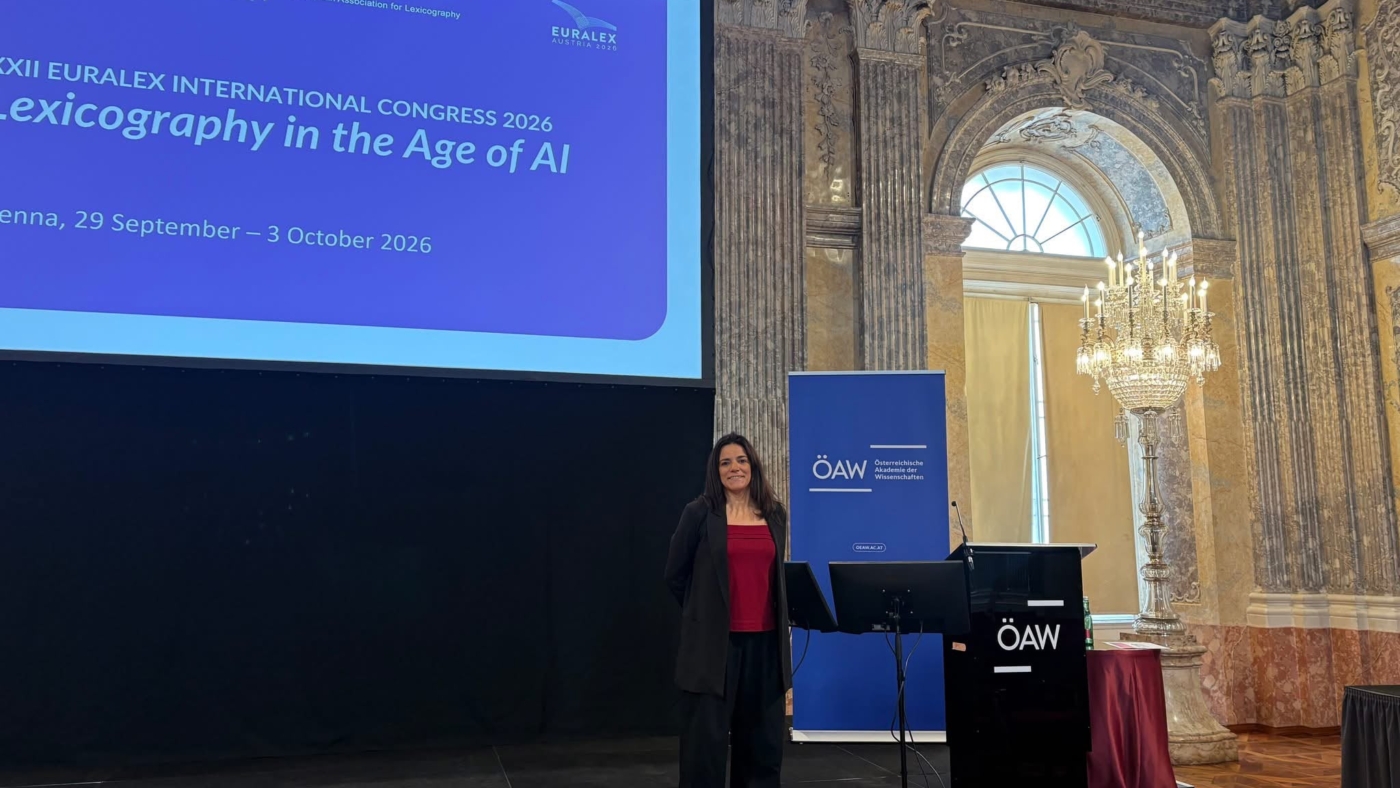
The Institute of Lexicology and Lexicography of the Portuguese Language (ILLLP) of the Academy of Sciences of Lisbon took part in the EURALEX 2026 international conference, held between 29 September and 3 October at the Österreichische Akademie der Wissenschaften (ÖAW) in Vienna.
Under the theme ‘Lexicography in the Age of AI’, the 2026 edition brought together lexicographers, researchers, publishers and specialists in language technologies to discuss the impact of artificial intelligence and natural language processing on the production, revision and use of lexicographical resources.
The ILLLP’s participation included a plenary lecture by Ana Salgado, President of the Institute, entitled “Dictionaries as Pipelines: Lexicographic Work at the Academy of Sciences of Lisbon”, delivered on 2 October.
The presentation proposed a view of the dictionary as a dynamic and continuously updated infrastructure, in which lexical data is collected, structured, validated and reused. The presentation drew on the lexicographical work currently being carried out at the Lisbon Academy of Sciences. It also highlighted the importance of transparent and documented editorial processes, as well as the role of the lexicographer in data validation and governance, in a context where computational tools and artificial intelligence systems are playing an increasingly significant role in lexicography.
The ILLLP was also represented by Leonor Martins, a research fellow at the Academy of Sciences of Lisbon as part of the PORTULAN CLARIN project (LISBOA2030-FEDER-01316900), co-funded by the European Union through the Lisbon 2030 Programme (ERDF), with the paper “Neologisms in Evaristo.ai vs. ChatGPT: Implications for LLM-Based Lexicography in European Portuguese”, co-authored with Ana Salgado. Presented on 3 October, the study compares how Evaristo.ai and ChatGPT handle neologisms, seeking to assess the implications of using large language models in the production of lexicographical information for European Portuguese.
The work forms part of the current debate on the possibilities and limitations of artificial intelligence applied to lexicography, particularly with regard to the automatic generation of lexicographical content, the reliability of the responses produced by the models, and the need for specialised human validation.
The ILLLP’s participation in EURALEX 2026 reinforces the Lisbon Academy of Sciences’ presence in the international debate on the future of lexicography and highlights the work being carried out at the intersection of lexicographical research, structured data and artificial intelligence, with particular attention to the resources and specific characteristics of European Portuguese.